Vehicle Controls
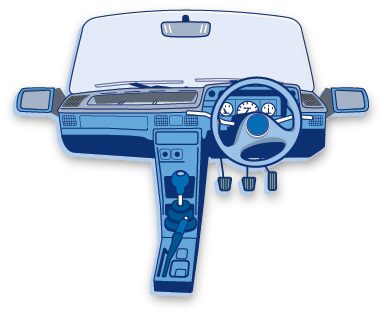
- Accelerator Press the accelerator down to make the vehicle move. If you are in reverse gear you will move backwards, if you are in any of the other gears you will move forwards. The more you press down, the faster you will go. The accelerator must only ever be pressed down with the right foot. The clutch also needs to be engaged (not pressed down) for the car to move forwards.
- Brake pedal This brake is known as the service brake, or foot brake. Press the brake pedal down to slow the vehicle or to stop. The brake pedal must only ever be pressed with your right foot.
- Clutch pedal Press the clutch pedal down when changing gears. The clutch pedal must only ever be pressed with your left foot. When you are not using it, you must rest your left foot on the floor to the left of the clutch, not on the clutch pedal. Automatic vehicles do not have a clutch pedal.
- Gear Lever Use the gear lever to select or change gears. Your clutch needs to be in if you are changing gears. Reverse is a gear, and you need to be in reverse if you want to move backwards. You choose gears according to the speed at which you are travelling. When you first move off, you must be in first gear. After that, generally the faster you are going the higher the gear you use. You should use a lower gear when you are going down a hill and you don't want the vehicle to speed up too much, or when you need more power (for example when you are going up a hill). While your car is stationary you should use neutral.
- Parking brake This brake is also known as the handbrake. Pull the parking brake up to keep the vehicle stationary while you are stopped or when you leave the car. Put it down again before you move off. You must only ever use the parking brake after the vehicle has come to a complete standstill, and not while you are still moving. Use the ratchet release (the button on the end of the parking brake) when putting it up or down.
- Direction indicator The direction indicator stalk switches on the indicator lights on the outside of your car. It could be found on the other side of the steering wheel depending on the make of car. Push the control up or down (in the direction in which you will be turning the steering wheel) to indicate to other drivers that you want to move or turn towards the left or the right. Put the control back to the middle to cancel the signal when you have finished turning (most times the signal will cancel itself). On most cars the controls for switching the headlights on and off and for changing between main beams and dipped beams are also on this stalk.
- Rear-view mirror This is the rear-view mirror, or interior mirror. Look in the mirror to check that it is safe behind your vehicle. You should check the rear-view mirror every 5-8 seconds when you are driving, as well as every time before you brake or signal.
- Side mirror This is the exterior, or side mirror. Most cars have exterior mirrors on both the driver's and passenger's sides. Look in the mirrors to check that it is safe behind your vehicle. You may check these mirrors every 5-8 seconds while you are driving when you check the main rear-view mirror, but you should especially check them when you are changing direction (check the mirror in the direction in which you want to turn). Be aware that there are some areas next to your car that you can't see in these mirrors. These are called blind spots and have to be checked by turning your head and looking back through the windows.
- Speedometer The speedometer shows you how fast you are travelling. Check the speedometer every now and then to ensure that you are within the speed limit. The speedometer also usually shows the mileage, or total distance that the car has travelled.
- Steering wheel Turn the steering wheel to change direction. When driving, keep both hands on the steering wheel, except when changing gears or giving hand signals. At these times you must always keep at least one hand on the steering wheel, and replace the other one as quickly as you can. If the steering wheel was a clock you would place your left hand at the 10 and your right hand at the 2.
- Temperature/Oil gauge The gauges give you information about your engine. Most cars have a temperature gauge telling you how hot the engine is, an oil gauge or warning light to tell you when your oil is low, a fuel gauge to tell you how much petrol you have in your car, and a rev counter to tell you how fast your engine is revolving. Most of the gauges have warning sections marked in red to show you when you are beginning to get out of the safe limits. Check the gauges every now and then to ensure that it is safe to drive or if you need to take action.
- Wiper stalk The wiper stalk controls the windscreen wipers on the front windscreen. It could be found on the other side of the steering wheel depending on the make of car. You should switch your windscreen wipers on when it is raining to keep your windscreen clear and make sure you can see the road ahead. The wipers can also be used to clean the windscreen if you spray water on them first (usually with a button on the wiper stalk). If you use the wipers while the windscreen is dry they can scrape a bit and sometimes spread dust across it which makes it harder to see.